
Today’s problems with tomorrows technology
Not only parameters controls
Traditional bioreactor software focuses only on control parameters (pH, DO, agitation, temperature). But when it comes toscaling up a bioprocess– from lab-scale reactors to industrial production – the critical challenges are hidden influid dynamics and mass transfer.
The first to integrate real-time CFD and kLa calculations directly into the control software.
CFD simulations offer insights into flow patterns and mixing efficiency. kLa calculations quantify oxygen transfer in real time, allowing users to predict process behavior at different scales without trial-and-error.
Users canoptimize agitation speed, gas flow, and impeller designduring experiments. This reduces wasted runs, lowers development costs, and accelerates process transfer.
Today, biotech companies often rely onoffline studies or external consultancyto estimate CFD and kLa. Thewaico embeds these toolsnatively in the bioreactor, giving end userson-demand answers.
Scale-up failures pose major risks in biopharma. Thewaico offers real-time insights to reduce uncertainty in technology transfer.
 Name.
Name.AI Machine Learning and predictive logic to boost performance
Machine learning can predict biotechnological performance based on variables like temperature, pressure, and pH, optimizing conditions to maximize yield.
Machine learning develops predictive models for optimal control of processes, ensuring stability and consistency.
Machine learning algorithms efficiently identify optimal nutrient combinations to maximize biomass or metabolite production.
Real-time data analysis with machine learning detects deviations, preventing problems and enabling timely interventions.
Machine learning can be used to optimize the separation and purification processes of biotechnology products, reducing costs and improving yield.
 Name.
Name.Measuring real impact means achieving quantifiable results and strategic outcomes in biomanufacturing
01
Faster bioprocess development
Less trial-and-error, more science-based optimization.
02
Reduced costs
Fewer failed runs, better predictability at larger scales.
03
Higher success rates
Improved reproducibility and regulatory confidence.
04
Smarter operations
Bioreactors that don’t just control, butanalyze and predict.
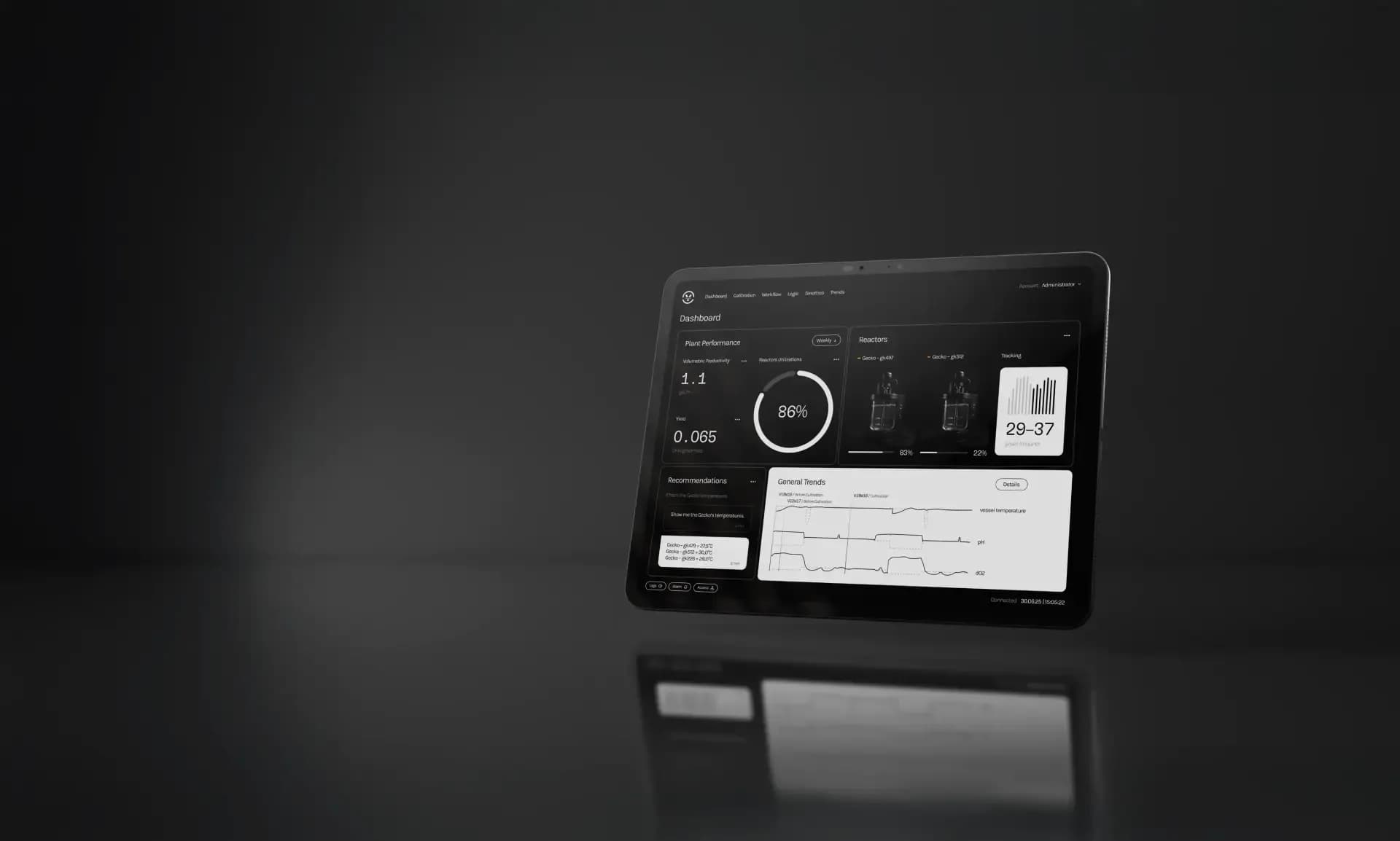
All of this is in our software Morpheus
ZEBRA is the intelligent and adaptable software platform at the heart of every Waico bioreactor. It combines robust PLC-based automation with advanced AI and simulation tools, offering a tailored experience for both lab-scale research and industrial production.